The Complete Guide
Custom Made Corner Lounge Covers — The Complete Owner's Guide
Corner lounges are the centrepiece of a lot of outdoor living spaces — and they are also one of the hardest pieces of furniture to protect properly. This guide covers everything you need to know before ordering a custom cover for an L-shape lounge.
Why corner lounges need a different kind of cover
An L-shape outdoor lounge is one of the most awkward shapes to cover well. Most off-the-shelf covers are designed for a rectangular sofa — typically 200 cm or 240 cm long, with a single seat depth front to back. A corner lounge breaks that pattern in two important ways. First, it has two distinct returns that meet at a 90-degree corner. Second, the chaise return is usually deeper than the back run, which means the cover has to step in and out as it travels across the piece.
A square or rectangular cover thrown over an L-shape will either gap badly at the corner — letting in rain, leaves, dust and insects — or bunch up dramatically on the chaise side and drag along the ground. The result is the same either way: water collects in the folds, the cover sags, the inside stays damp for days, and over a season or two you end up with mould on the underside and mildew on your cushions.
A custom-made corner lounge cover sidesteps all of that. Because every panel is cut to your specific dimensions, the cover sits flush against the back, drops cleanly down the chaise, and seals the corner properly.
The six measurements that matter
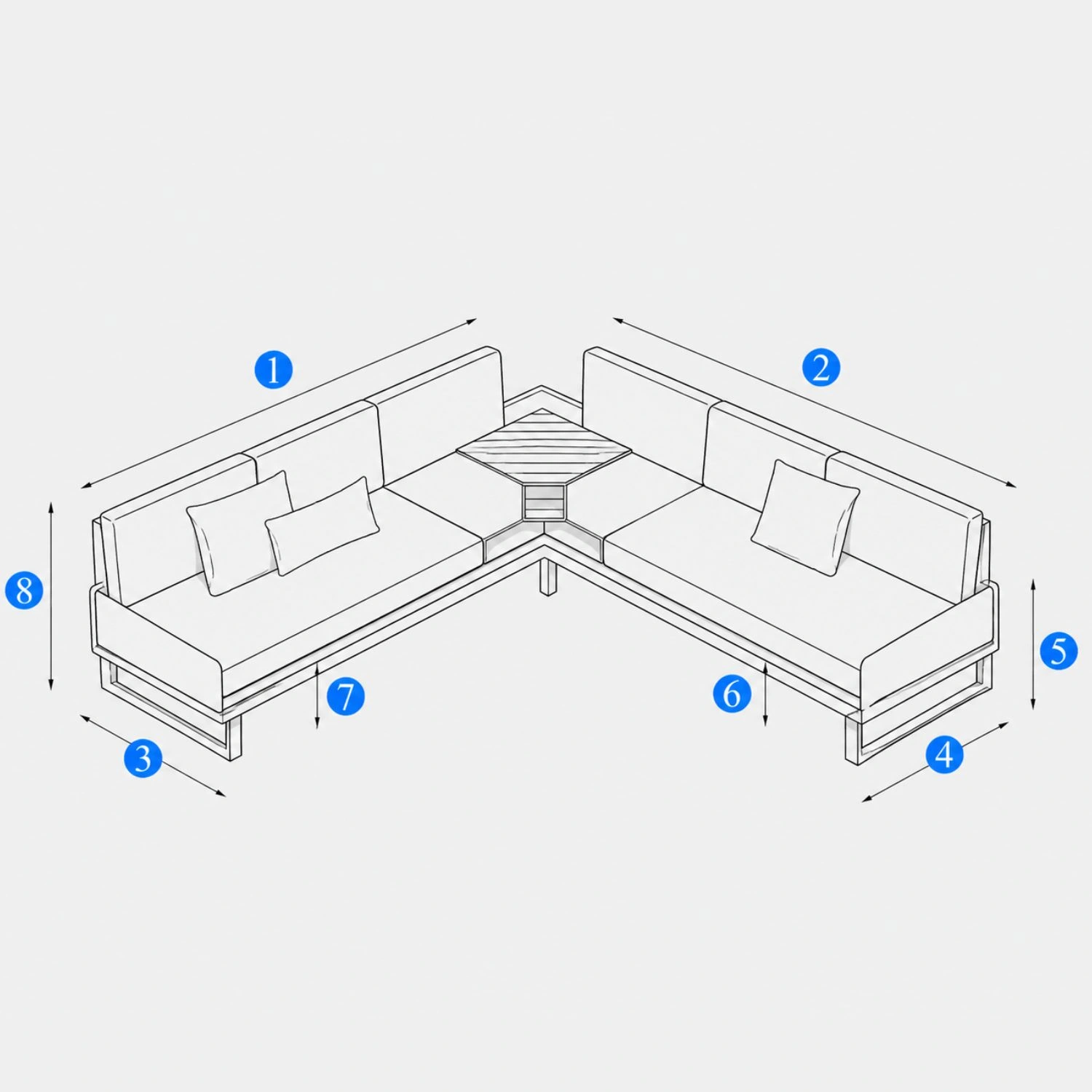
The single biggest factor in how well a custom cover fits is the quality of the measurements you submit. For a corner lounge, six dimensions are needed. Do not add any extra centimetres — the cover gets a small ease allowance built in so it goes on and comes off easily without flapping or pooling water.
1. Length of the back run
Measure the longer side from the outside edge of the armrest (or outside edge of the last seat module if armless) to the outside edge of the corner module. Take this at the very back of the piece, along the top edge. Most corner lounges have a back run somewhere between 220 cm and 320 cm.
2. Length of the chaise return
Measure the shorter side of the L — from the outside edge of the corner module to the far end of the chaise. Take this measurement along the front edge of the chaise, because the chaise is usually deeper than a normal seat module.
3. Overall height
Measure from the ground to the top of the back cushions, with cushions in their normal upright position. Do not compress them. The cover sits over the top of the cushions, so any slouching at the time of measurement will mean a cover that is slightly too short.
4. Depth of the back run
The front-to-back depth of the lounge along the back run, measured at the deepest point. On most modern outdoor lounges the seat cushion overhangs the base, so always measure to the front of the cushion.
5. Depth of the chaise
The chaise is almost always deeper than the back run — sometimes by 20 cm or more. Measure from the back of the chaise to the front edge, including any cushion overhang. Use a tape laid flat across the seat surface rather than running it down the front.
6. Chaise height
If your chaise has its own back, you can use the overall height from measurement three. If the chaise is a flat extension or an ottoman-style return without a back, measure separately from the ground to the top of the chaise cushion. This lets the cover step down at the right point.
Why fabric quality is everything
The thing that separates a cover that lasts five years from one that fails in twelve months is fabric construction. There are three things to look at: the face fabric, the waterproof coating, and UV resistance.
Face fabric
The outer face of a quality outdoor cover is solution-dyed polyester. Solution-dyed means the colour is added to the polymer before the fibre is extruded, rather than dyed onto pre-made fabric. The colour goes all the way through every fibre, which means the fabric resists fading dramatically better — and even when it does eventually fade, it fades evenly rather than going blotchy. A 200gsm weight is a good baseline: heavy enough to feel substantial and resist tearing, light enough that one person can put it on and take it off without a struggle.
Waterproof coating
The face fabric is not waterproof on its own. The waterproof barrier is a coating bonded to the underside — typically polyurethane (PU). PU coatings are flexible, do not crack when the cover is folded for storage, and hold up well under UV exposure. Avoid covers with PVC coatings, which go brittle after a year or two of sun and crack along fold lines.
UV stabilisation
UV exposure can be intense and damaging depending on your location. A solution-dyed fabric with a stabilised PU coating will typically last five to seven years in full sun without significant degradation. Non-stabilised materials can start chalking and flaking within eighteen months.
Caring for your cover
Rinse with a garden hose every few months to wash off pollen, salt and dust. Spot-clean bird droppings with mild soapy water rather than letting them dry into the coating. Do not machine wash — the agitation strips off the waterproof coating in a single cycle. When taking the cover off for storage, fold it loosely rather than scrunching it; repeated fold lines in the same place can develop micro-cracks in the coating over time.